|
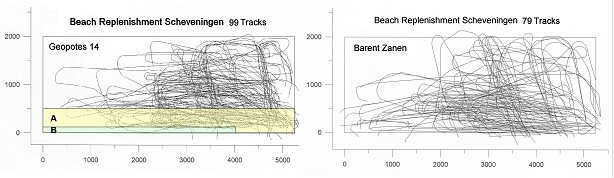
Eco-efficient surface sand mining (At least 80% less damage to benthic communities) written by Ronald van Oostrum Introduction Mining of seasand has become common practice both in developed and developing countries. Seasand is used for all kinds of projects like land reclamations, the construction of artificial islands, coastline stabilization and industrial purposes. These projects have economical and social benefits, but seasand mining can also have detrimental effects on the local marine ecology, on coastline stability and on fisheries. In many countries, including the Dutch section of the Northsea, offshore sand mining is allowed up to a maximum depth of 2 m below the seabed (in navigational channels up to 5m). The approved sand mining exploitation areas are always large enough to collect the required sand volume. The common sand mining method As an example the sailed tracks of two trailing suction hopper dredgers (TSHD’s) working on a 1 million m³ beach replenishment project are presented in figure 1. The official dimensions of the allocated mining area were 5250 x 2000 meter, which leads to a total surface area of 10,5 km². As can be seen in these figures, the actual sand mining was spread over a large part of the mining area. The average layer thickness removed by the dragheads of the TSHD’s was approximately 35 cm. Based on the layer thickness and the dredged volume (including a correction of 10% for track overlap) it was calculated that approximately 25% of the surface layer of the entire mining area was removed by dredging. This corresponds with area A (5250m x 500m = 2,6 km²) in figure 1. Actually, due to the overflow process during sand dredging, the dredged area was about 20% larger.
Figure 1: Sailed tracks of two trailing suction hopper dredgers Geopotus 14 and Barent Zanen (source: EDC). Since the benthic organisms are living in the top 30 – 40 cm of the seabed and on the seabed, the damage to the benthic communities is more or less equal to the dredged area. Consequently this mining method maximizes the damage to the so-called life-layer of the seabed. For the more mobile organisms, which can move around during the sand mining project, the damage will be a little bit less. Eco-efficient sand mining method If mining is carried out up to the accepted depth limit of two meters, a completely different situation originates. Based on the sand volume required and an average layer thickness of 2 m, the total area required for dredging is limited to about 0,5 km². This is less than 20% of the surface area calculated for the original mining method, and corresponds with area B (125m x 4000 m) in figure 1. If mining is carried out up to the accepted depth limit of two meters, a completely different situation originates. Based on the sand volume required and an average layer thickness of 2 m, the total area required for dredging is limited to about 0,5 km². This is less than 20% of the surface area calculated for the original mining method, and corresponds with area B (125m x 4000 m) in figure 1. In figure 2 the environmental profits for the benthic communities with increasing depth is presented. With an average mining depth of 2 m the profit is about 81% (81% less surface area mined), whereas with an average depth of 3 m the profit is about 87%. 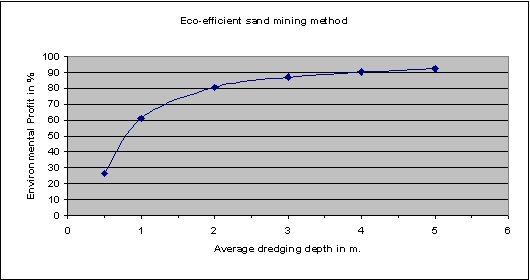
Figure 2: Less damage to benthic communities due to deeper surface mining (source: EDC). Since hardly any organisms can be found deeper than 40 cm in the seabed, sand mining up to 2 – 3 m will not cause additional ecological effects. Consequently, it is recommended to place requirements with respect to the minimum dredging depth during surface mining in the seasand mining permit. This will lead to a strong reduction in ecological damage. |
|